
Jungian Cognitive Functions
This test comes in 20-question and 70-question versions. Each question has 10 points and four options. You need to distribute the points among the four options. Please follow your first instinct when distributing points.
Both the 20-question and 70-question versions generate the same report. The 20-question version is more susceptible to short-term mood or environmental influences, while the 70-question version yields more stable results.
Choose what feels more natural to you, rather than what you think you should do.
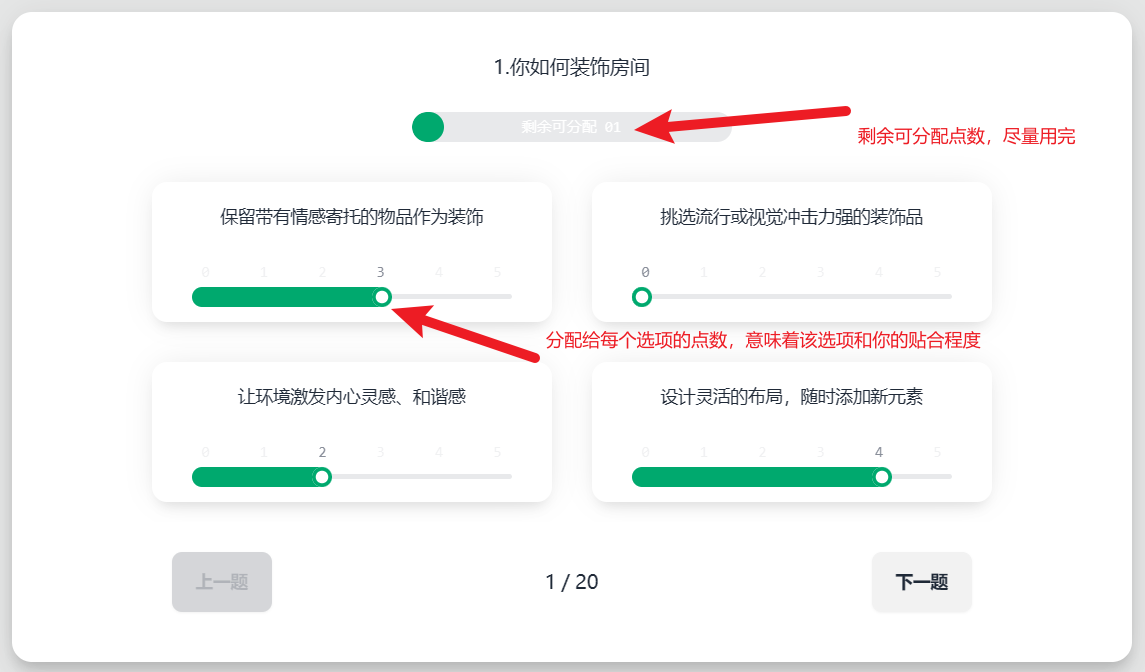
It may take approximately 8-10 minutes (20-question version) or 20-25 minutes (70-question version).
Upon completion, you will receive a report including cognitive function scores, analysis, and personality type inference.
The latest version saves your answer selections along with the report, allowing you to compare your results with yourself or others who used the same version.
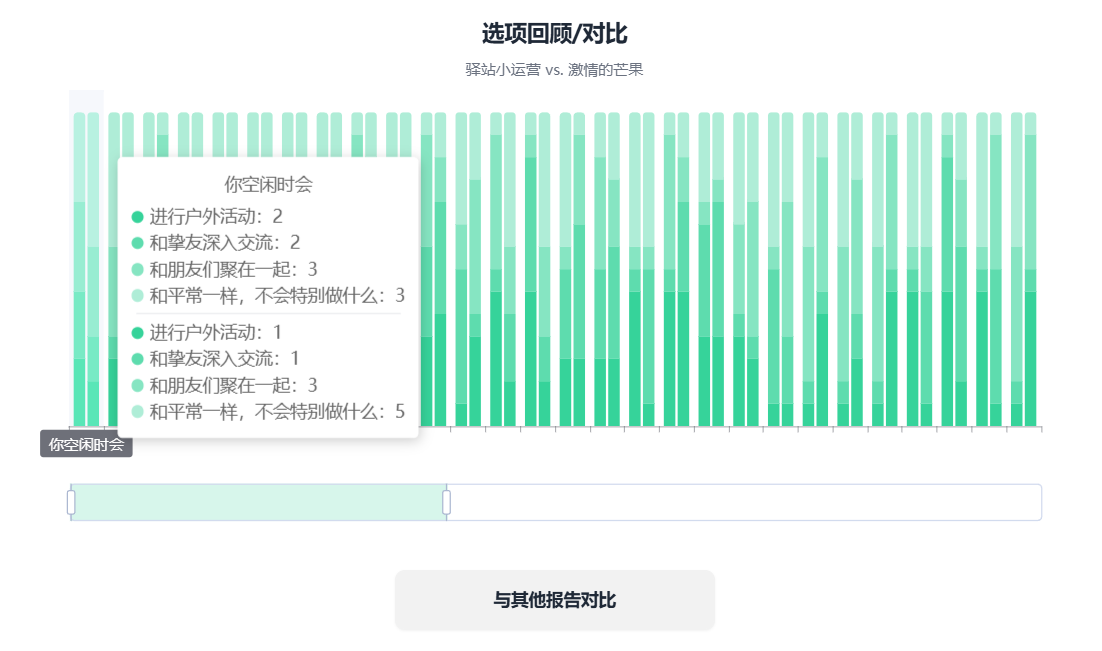
This feature and all subsequent reports and updates are completely free.
If you want to manually input cognitive function scores, you can use the Cognitive Function Calculator.
The Myers-Briggs Type Indicator was created by Katharine Cook Briggs (1875-1968) and her daughter Isabel Briggs Myers (1897-1980). Neither had a formal psychology background. The mother was a teacher with a lifelong interest in personality, who gained some recognition by writing about how she raised her daughter.
After her daughter went to college (studying political science), the mother became depressed. In 1923, she read Carl Jung's "Psychological Types" and developed personality type variants based on Jung's theory: Introversion/Extraversion, Intuition/Sensing, Feeling/Thinking, with an additional Judging/Perceiving dimension.
The daughter expanded this theory into a questionnaire and sold it to her good friend Edward N. Hay, an employee consultant whose job was to help companies determine whether employees were suitable for certain positions.
From the end of World War II to the early arms race, the type indicator became hugely popular in the United States.
Jungian analyst John Beebe combined Jung's "Psychological Types" with personality types to propose the Jungian Eight-Function Model (Beebe Model), and authored "Energies and Patterns in Psychological Type".
| Function | Extraverted (E) | Introverted (I) |
|---|---|---|
| Sensing | Se | Si |
| Intuition | Ne | Ni |
| Thinking | Te | Ti |
| Feeling | Fe | Fi |
The traditional personality type indicator uses a dichotomous approach, dividing 16 types along four scales (I-E, S-N, T-F, J-P), while the Jungian Cognitive Function Model focuses more on consciousness types rather than personality temperament types.
The Jungian Cognitive Function Model divides functions into two categories: Judging functions and Perceiving functions, introducing the concepts of the Perceiving axis, Judging axis, and function positions.
Both ends of the Perceiving axis are perceiving functions, and both ends of the Judging axis are judging functions.
If one function is extraverted, the next is introverted (receiving information is followed by processing it). So the two judging functions (T/F) combined with attitude (I/E) have 4 possibilities: Ti-Fe / Te-Fi / Fi-Te / Fe-Ti. The perceiving axis follows the same rule. Combining the two axes forms a Jungian cognitive function archetype, with 16 possible combinations.
The 16 archetypes derived from function positions in the Jungian model correspond to the 16 personality types in the type indicator.
| Type | Dominant | Auxiliary |
|---|---|---|
| INTJ | Ni | Te |
| INTP | Ti | Ne |
| ENTJ | Te | Ni |
| ENTP | Ne | Ti |
| INFJ | Ni | Fe |
| INFP | Fi | Ne |
| ENFJ | Fe | Ni |
| ENFP | Ne | Fi |
| ISTJ | Si | Te |
| ISFJ | Si | Fe |
| ESTJ | Te | Si |
| ESFJ | Fe | Si |
| ISTP | Ti | Se |
| ISFP | Fi | Se |
| ESTP | Se | Ti |
| ESFP | Se | Fi |
The personality type indicator and the Jungian Cognitive Function Model are two systems that are both independent and interrelated. Results may differ, and although they share the same type names, the underlying meanings can be somewhat different.
The Barnum effect is a psychological phenomenon named by psychologist Bertram Forer in honor of showman P.T. Barnum. People tend to rate personality descriptions as highly accurate when they believe the descriptions are vague and general, even though the descriptions are broad enough to apply to almost anyone. The Barnum effect provides a thorough explanation for the widespread acceptance of pseudosciences such as astrology, fortune-telling, and many personality tests.
In my view, however, these kinds of tests are not entirely useless. Much like a person who flips a coin to make a decision -- the point is not to let the coin decide for you, but to notice what you hoped for the moment the coin was in the air. Through these tests, you can also catch a glimpse of your subconscious expectations for your own self-image.
Therefore, I hope you won't blindly believe in the test results, but rather reflect on the results and the process. For positive psychological suggestions, once you recognize them as aspirations for yourself, take action. For negative psychological suggestions, recognize them as mere self-suggestion, and consciously avoid the influence of negative suggestions.