

Self-Typing Tool
"No test can truly capture your type." -- A saying in the typology community
Traditional personality tests use a "scoring method" that measures an individual's habitual use or preference for certain functions. This fundamentally follows trait theory logic -- a higher score means greater proficiency or preference. However, Jungian cognitive functions follow type theory, where the core isn't about "frequency of use" but rather the individual's inner attitude toward different functions. Therefore, compared to relying on tests, self-typing is generally recommended.
Self-typing isn't about choosing what you would do, but about examining your attitude toward how things are done in a given scenario, based on the rules of Jungian cognitive function archetypes. You compare your function-attitude model to see which personality type archetype it most closely resembles.
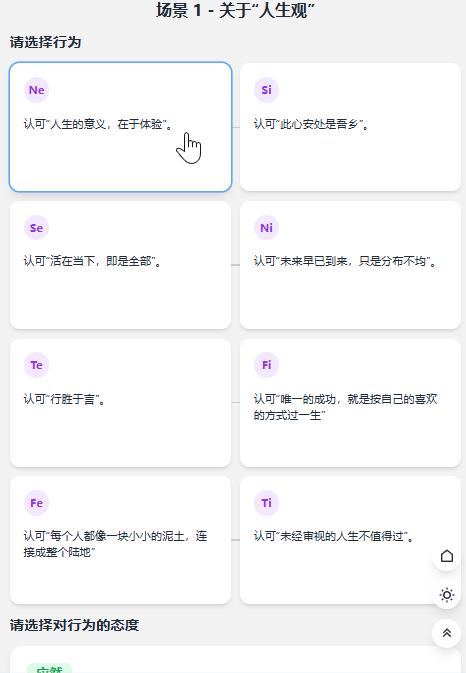 Match functions with attitudes and rate them
This tool includes built-in scenarios, functions, and position attitudes. Regarding functions and position attitudes, users are encouraged to judge based on their own understanding and can customize any scenarios or options they find unsatisfactory -- there's no need to strictly follow the descriptions provided by the tool.
Jungian cognitive functions and personality typology form a fluid symbolic system. As with any symbol, different groups and individuals will interpret them differently. What matters is the shared understanding between users, not external definitions of what the symbols should mean.
After saving, custom questions can also be shared with others for testing, facilitating mutual alignment between discussion partners.
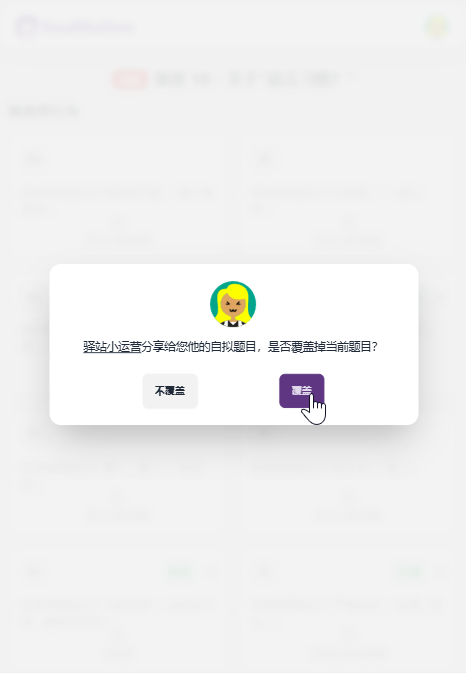 Customize questions and share
According to Beebe's theory, not everyone can be neatly categorized into 16 archetypes. It's perfectly normal if no combination fits you exactly -- just get as close as possible.
The Barnum effect is a psychological phenomenon named by psychologist Bertram Forer in honor of showman P.T. Barnum. People tend to rate personality descriptions as highly accurate when they believe the descriptions are vague and general, even though the descriptions are broad enough to apply to almost anyone. The Barnum effect provides a thorough explanation for the widespread acceptance of pseudosciences such as astrology, fortune-telling, and many personality tests.
In my view, however, these kinds of tests are not entirely useless. Much like a person who flips a coin to make a decision -- the point is not to let the coin decide for you, but to notice what you hoped for the moment the coin was in the air. Through these tests, you can also catch a glimpse of your subconscious expectations for your own self-image.
Therefore, I hope you won't blindly believe in the test results, but rather reflect on the results and the process. For positive psychological suggestions, once you recognize them as aspirations for yourself, take action. For negative psychological suggestions, recognize them as mere self-suggestion, and consciously avoid the influence of negative suggestions.