Author: Jiuge
Li Mao: My thanks to Jiuge for completing this article. During discussions of the second version of the eight-function test at the end of 2024, Jiuge mentioned an insight about explaining the eight functions through information-processing psychology. I found it fascinating and remarkably coherent, so I encouraged Jiuge to write it up. Over three months, Jiuge worked carefully and conscientiously to finish the piece, which went through complete rewrites and repeated refinement along the way. This entirely new perspective on the eight functions is a work of genius and very much worth reading.
My thinking about "explaining Jung's eight functions through information-processing psychology" began during an early community discussion, in a fascinating debate about mysticism and science. As someone who believes in scientism (this is only my personal view; it does not mean I deny the existence of mysticism), I began to wonder: could we approach this from the perspective of modern science, open up a new angle, and try to explain Jung's eight functions in a fresh way?
Then I thought of cognitive psychology. Cognitive psychology divides human cognition into sensation, perception, attention, thinking, feeling, and volitional behavior—a division that overlaps to some extent with Jung's eight dimensions. Encouraged by Li Mao, I tried to explore the idea and build a model.
Special note: this model is only a hypothetical model I have constructed. It does not yet have empirical scientific standing.
Before trying to explain Jung's eight functions through information-processing psychology, we need to lay out the basic theories of both. Since most readers are already familiar with Jung's eight functions, this article will not restate that theoretical system; it will focus instead on a brief introduction to information-processing psychology.
By the mid-twentieth century, three major theoretical camps dominated explanations of complex human behavior: the Gestalt school, which emphasized holistic perceptual organization; neo-behaviorism, which emphasized stimulus–response connections; and information-processing psychology, which took cognitive processes as its core. As a central branch of cognitive psychology, information-processing psychology opened the "black box" that behaviorism placed between stimulus and response, and set out to reveal the internal cognitive mechanisms that lie between stimulus input and behavioral output.
The computer offered information-processing psychology a convenient metaphor: the human brain as a physical symbol system. By building modular flowcharts, researchers tried to simulate human cognition with computer architecture.
Within this framework:
The external stimuli and the objects the brain processes are "physical symbols that represent information"—language, images, written words, and so on.
The brain performs input, encoding, storage, retrieval, copying, and transfer on these symbols, completing a series of complex cognitive processes.
The figure below sketches the basic frameworks of the human information-processing system and the von Neumann computer architecture:
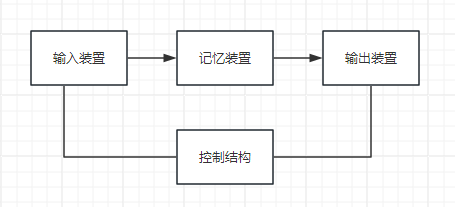
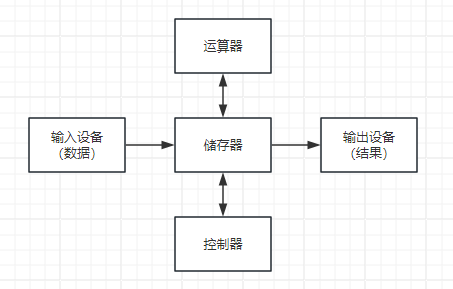
Researchers in information-processing psychology use computer architecture to simulate human cognition, and they also apply findings from the study of human cognition to computers—the field we know as artificial intelligence.
This is a fascinating discipline. Space prevents a fuller and more precise account, but interested readers can consult further sources and explore it in depth.
The figure below is a sketch of the "Jungian eight functions–information-processing psychology hypothetical model" I attempted to build:
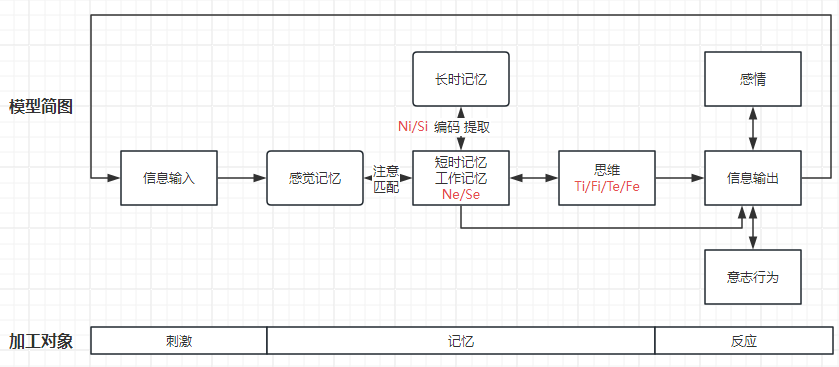
After external "stimuli" enter through the perceptual system (vision, hearing, and so on), they undergo encoding, storage, retrieval, and other cognitive processes and are transformed into "memory." When a new situation arises, "memory" is reactivated and takes part in thinking, generating behavioral or emotional "responses." These "responses" themselves become new "stimuli," re-entering the perceptual system and continuing the cycle. Stimulus, memory, and response are not isolated; they have no clear boundaries and interact in real time.
For simplicity, the following discussion uses "information" as an umbrella term for all cognitive carriers in this cycle—stimuli, memories, and responses.
Every kind of mental activity and processing strategy exerts a directional influence at each stage of the information flow. For example, N (intuition) tends to compress information into abstract concepts that cut across situations; S (sensing) tends toward display, strengthening the storage precision of raw sensory detail.
This directional pull reshapes the structure of information the way gene editing reshapes a genome, so that processed information carries a distinct imprint of the function.
In other words, once information has been processed it already carries different cognitive-function tendencies. Different functions leave different imprints on the information flow, molding it into different shapes and thereby shaping the path of later cognition and behavior.
To keep the hypothetical model manageable, we assume that an individual's total cognitive resources are constant and that a controller dynamically allocates those resources among the cognitive functions. Differences in allocation patterns produce different cognitive styles.
The classic text Gifts Differing divides Jung's eight functions into perceiving and judging. I will use that framework to unpack the eight functions.
Sensory information enters and, after being filtered by attentional mechanisms, reaches the short-term memory (working memory) stage. Short-term memory has two subsystems:
Direct memory: raw sensory information that has not been deeply processed and is held in the brain only briefly (roughly 0.5–2 seconds).
Processed memory: current stimuli, or information retrieved from long-term memory, are re-encoded here; logical reasoning and other thinking activities also take place at this stage.
In the hypothetical model, the extraverted perceiving functions Ne/Se occur mainly at the short-term (working) memory stage, and their operation shows two tendencies:
A display-style capture of more external detail (Se)
Leap-style associations built by compressing the paths between pieces of information (Ne)
Most earlier accounts of Ne treat it as diffuse. I think Ne's diffusion lies only in the breadth of its associations. In essence, Ne raises the efficiency of association by compressing the paths between pieces of information. Under the assumption of constant total cognitive resources, Ne's leap does not mean access to a larger total quantity of information; instead, it trades detail precision for associative possibility—just as choosing teleportation to cross a city means losing the scenery along the way.
Ne and Se seem to have a spatial character. Because short-term memory is dynamic and updates in the present moment, the information space Se constructs shows the real distances between things, whereas Ne crosses space: the distances between things are compressed and hard to pin down.
Evidence that may support the hypothetical model:
In Cognition: Thinking and Intelligence Behind Human Behavior, Simon describes a dual-channel decision model operating at the short-term memory stage:
Internal guidance strategy: a tendency to retrieve and combine existing information as guidance for forming a response.
Stimulus-directed strategy: a tendency to sense the current situation or stimulus through the sensory organs and draw a response from it.
These two strategies may share a certain family resemblance with the ways Ne and Se process information.
After processing in short-term memory, information is encoded into long-term memory through the hippocampus and finally stored in different regions of the cerebral cortex.
In the hypothetical model, the introverted perceiving functions Ni/Si occur mainly at the long-term memory encoding stage, in two modes:
Display-style storage in the form of a "situational archive" (Si)
Compression-style storage in the form of a "conceptual index" or "keyword tags" (Ni)
Under the constant-resources assumption, Si spends resources on a large volume of detailed situational memories, and Ni's compression also costs resources. After compressing information, Ni may gain indexing efficiency, whereas Si trades indexing efficiency for the preservation of detail. A remark from Wulongjiu—"a tree is the set of trees"—shaped my understanding of how Ni and Si preserve memory. In an Si mind, a tree is each particular tree in memory, growing at dusk or dawn, budding or withering; in an Ni mind, a tree is the set of trees, a symbol and concept of "tree" compressed from every remembered tree.
Ni and Si seem to have a temporal character. Because long-term memory keeps accumulating, updating, storing, and layering, Si gradually gathers concrete events along the timeline and recounts them in sequence, whereas Ni compresses information from many points in time into abstract concepts that cut across time.
Evidence that may support the hypothetical model:
Semantic compression: abstract concepts (such as "freedom") have high information density but blurred detail, while concrete words (such as "plane tree") are rich in detail but have little extensibility.
Sharp-wave ripple experiments (Buzsáki, 2015):
Awake period: the hippocampus records the rat's maze path frame by frame (A → B → C).
Sleep period: the same memories replay at high speed in the hippocampus and are compressed and recombined (A → C), forming an optimized model for spatial navigation.
Jung's use of "dreams" and "the unconscious" to explain "Ni" seems to connect with this.
Ne and Se are not a binary opposition. They depend on each other and stay in dynamic balance; most people sit between the two, showing different tendencies because cognitive resources are limited and allocation patterns differ. For example, at the instant a leaf falls, if you associate it with a fluttering butterfly, you cannot at the same time observe the structural beauty of the leaf's veins—and yet real sensory input is still the precondition for your association.
Ni and Si are likewise not a binary opposition but a relationship of mutual completion and dynamic adjustment. Too much abstraction loses its footing in reality; too much detail loses creativity.
Information-processing psychology's production systems can explain the dynamic interaction among Ne, Se, Ni, and Si.
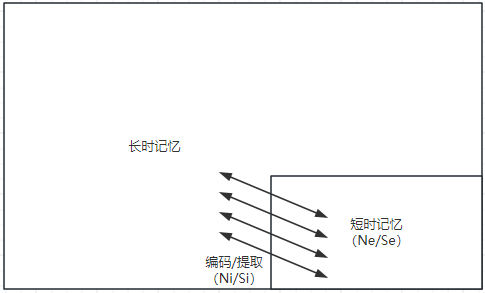
Within production systems, EPAM theory and spreading activation theory explain the continuous dynamic exchange between short-term and long-term memory. EPAM proposes that the interaction between short-term and long-term memory is essentially the construction of a progressively discriminating network. Spreading activation theory proposes that there is no separate short-term storage unit inside long-term memory—only a continuously active dynamic network. When an external stimulus arrives, the relevant parts of long-term memory are activated, and that activated subset is what we call short-term memory. This cognitive mechanism offers a useful analogy for how Ni, Si, Ne, and Se interact and cooperate.
Moreover, according to the imprinting mechanism of cognitive processing, although Ne/Se do not directly take part in long-term memory encoding, information must first pass through preliminary Ne/Se processing in short-term memory before it reaches Ni/Si encoding in long-term memory. The information flow encoded by Ni/Si therefore already carries the cognitive imprint of Ne/Se. This processing pattern lets the features of Ne/Se-processed information seep continuously into the Ni/Si long-term encoding stage, while Ni/Si's reprocessing of the information flow feeds back through the memory cycle into the Ne/Se short-term encoding stage.
In the loop between long-term and short-term memory, Ne/Se and Ni/Si keep accumulating and layering each other's imprints.
In Psychological Types, Jung describes T (thinking) and F (feeling) as follows: "Thinking and feeling are rational functions, because they are decisively influenced by reflection. Thinking is a psychological function that follows its own laws and brings the contents of ideation into conceptual connection in a certain way. Feeling is primarily a process that takes place between the ego and a particular content, assigning that content a certain value in the sense of acceptance or rejection (liking or dislike)."
The classic text Gifts Differing describes T and F as follows: "By processing the information obtained through perception, an individual reaches conclusions. Different individuals reach conclusions in different ways. One way of judging is thinking—arriving at objective conclusions through rational logical processing. The other is feeling—evaluating things on the basis of personal subjective values, an evaluation that is likewise a rational process."
Both passages describe T and F as two rational functions. In the hypothetical model, I propose that:
The judging mechanisms of both T and F occur at the thinking stage; the difference is a tendency to judge right and wrong by objective logic versus good and bad by subjective feeling.
The difference between introverted and extraverted judging functions lies in whether they tend to trace causes or seek effects. Introverted judging functions (Ti/Fi) tend to explore inner, essential causes, while extraverted judging functions (Te/Fe) tend to shape external reality. The two complement each other.
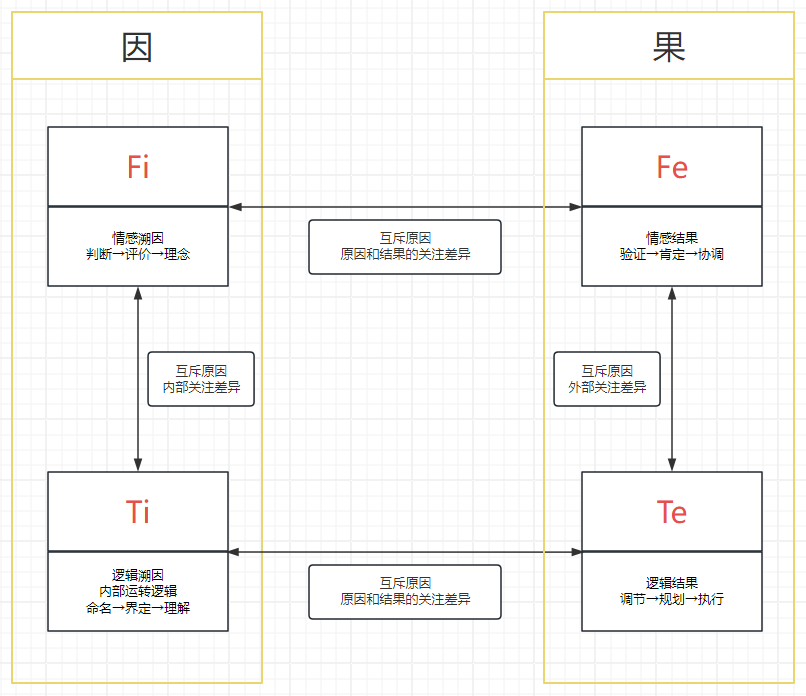
At this point we need to distinguish "thinking," "affect," and "volitional behavior" in information-processing psychology from "thinking" and "feeling" among Jung's eight functions.
T and F among Jung's eight functions are both judging tendencies.
In information-processing psychology, "thinking" is the process of knowing the essence and internal connections of things (including reasoning, analysis, and judgment), whereas "affect" is the experience elicited by external stimuli. Affect reflects the relation between an objective thing and the subject's needs and is an outcome experience.
Logical judgment can also trigger affect—for example, love for one's work or the sense of accomplishment that comes from verifying a proof.
Extraverted judging functions (Te/Fe) still belong to the thinking process; what they output are decisions and plans. Moving from a decision or plan to volitional behavior still requires further processing.
I do not think so. Each of the eight has its own value. People of every 16-type profile possess all eight dimensions, and their dynamic, complementary cooperation forms a complete cognitive system. That said, different environments can produce differences in how well a given 16-type profile fits a given setting.
I do not agree with the view that a person's 16-type profile can be fully determined from behavior. Under the information-processing framework, even when external stimuli and observable behavior are identical, internal cognitive paths can differ enormously. A and B, for example, may both proactively maintain relationships at work, but A may do so because she prefers working in a harmonious environment, while B may do so to avoid deliberate obstruction caused by a poor relationship, which would hurt work efficiency.
That said, internal cognitive paths are not incapable of influencing observable behavior. Se, for instance, is often labeled "strong in action," but in the hypothetical model Se is essentially a tendency to acquire sensory information, not action capacity itself. Because of that tendency, however, people high in Se may show an action advantage through frequent use of sensory channels; alternatively, innate sensory sensitivity may lead them to rely on those channels and gradually form an Se information-acquisition tendency.
This article has in fact left out the "controller" in information-processing psychology. Explaining the underlying mechanisms and causes of cognitive tendencies, however, would inevitably bring in developmental psychology and neuroscience, since cognitive tendencies may be shaped by both nature and nurture. That would be an enormous undertaking. I am not a professional psychologist and do not have the capacity to handle such a large research program, so this article does not discuss the causes of psychological tendencies. It focuses only on how cognitive mechanisms operate.
First, this hypothetical model is only a hypothesis, not a scientific theory supported by empirical evidence. I am not a professional psychologist and have no experimental environment. My discussion of Jung's eight functions is offered as a modest provocation—an attempt to find a new way of explaining them, to widen the scope of thought, and to draw in others who share an interest in Jung's eight-function theory for discussion and reflection.
In Cognition: Thinking and Intelligence Behind Human Behavior, Simon writes: "At present, some of the generalizations psychology has proposed cannot yet give precise qualitative descriptions; they are not laws with a qualitative structure, so psychological laws have only limited validity. For example, the claim that human problem solving is limited by short-term memory and by computational capacity is not especially precise—any more than 'disease is caused by germs' is precise. But it can guide us in analyzing problems and has a certain guiding value." The imprecision of a theory, then, does not stop us from trying to think and to build.
First, I thank Yuzhi, whose debate with me during an early community discussion sparked new thinking. I thank Li Mao for encouraging and supporting my attempt to build the model, Xiao Qi and Li Mao for recommending source materials, and Xiaoyu, Xuebi, Xiaojun, and Caiguai for their encouragement during the writing process.
