
Tarot Personality
Tarot and astrology share a common root: two ancient systems running in parallel. At the end of the nineteenth century, the magical order known as the Golden Dawn systematically mapped the two together: the 22 Major Arcana correspond to the 7 classical planets, the 12 zodiac signs, and the 3 elements; the 36 numbered minor cards correspond to the 36 zodiacal decans, each spanning 10° with its own ruling planet; and the 16 court cards correspond to the four modes of zodiacal energy.
These correspondences became widely known through the imagery of the classic Rider-Waite Tarot (1909) and became the standard model of modern tarot. This test is built on that century-old system: your result lands on a specific card and can also be traced to a complete astrological coordinate.
Decans: The Finer Scales Within a Sign
The decan originates in ancient Egyptian and Hellenistic astrology: each 30° sign is divided into three segments of 10°, each ruled by a planet. Within the roughly one month a sign covers, people born at the start and at the end of the month differ in temperament because their decan rulers differ.
Medieval Arab astrologers called these divisions "fascies." In the Book T (c. 1888), the Golden Dawn assigned the 36 decans one by one to the 2 through 10 of the four suits, so that the minor cards were no longer vague symbols of fortune but energy coordinates precise to the degree.
The test has 36 questions. Each question sets one scenario and offers four statements, each mapping to one zodiac archetype. You rate every statement on a five-level slider (Strongly disagree → Strongly agree). That makes 144 responses in total and takes about 20 minutes. The full report is free.
01 Zodiac Energy Vector
36 questions, 144 first-person statements, each tied to one zodiac sign (every sign appears exactly 12 times). Your response to a statement is counted toward that statement's sign; each sign's energy is the mean of all its appearances, on a scale of 0 to 4.
02 Dual-Algorithm Cross-Validation
The same responses are scored in two ways. The absolute-fit method aggregates raw responses directly, highlighting the archetypes you genuinely identify with; the relative-strength method first centers each question — subtracting that question's lowest response from every statement, setting the lowest item to zero and keeping the gaps for the rest — to highlight the archetype you lean toward within the same scenario. The two methods score independently and corroborate each other; the Main Card decision follows the absolute method, switching to the relative method only in extremely rare ties.
03 Element × Mode × Planet Aggregation
The energies of the 12 signs are grouped by element (Fire / Earth / Air / Water) and mode (Cardinal / Fixed / Mutable) into a 4×3 distribution. In classical astrology every sign has a ruling planet, and planets are stronger or weaker in different signs (domicile, exaltation, fall): a ruling planet directly inherits the energy of the sign it rules; a planet gains half-weight in its sign of exaltation and loses half-weight in its sign of fall. After normalization, you get energy scores for the 7 planets, aligned with the traditional rules of classical astrology.
04 Layered Scoring Across the 78 Cards
Each card layer scores differently: Major Arcana take the zodiac, planetary, or elemental energy according to the Golden Dawn correspondences; Aces take the elemental energy of their suit; numbered cards score by decan sign energy × ruling planet energy, multiplied by a compression factor — a decan covers only a 10° segment of a sign, so its ceiling should be lower than a full-sign Major Arcana. Court cards score by suit element × rank mode, with the Page taking the average of the three modes. The 26 Major Arcana and Aces are uncompressed and occupy the highest score range, while numbered and court cards are compressed below them, so the Main Card always comes from the Major Arcana and Aces. If several cards tie, a fixed order unrelated to your answers is applied as the tiebreaker, ensuring every card has a unique score.
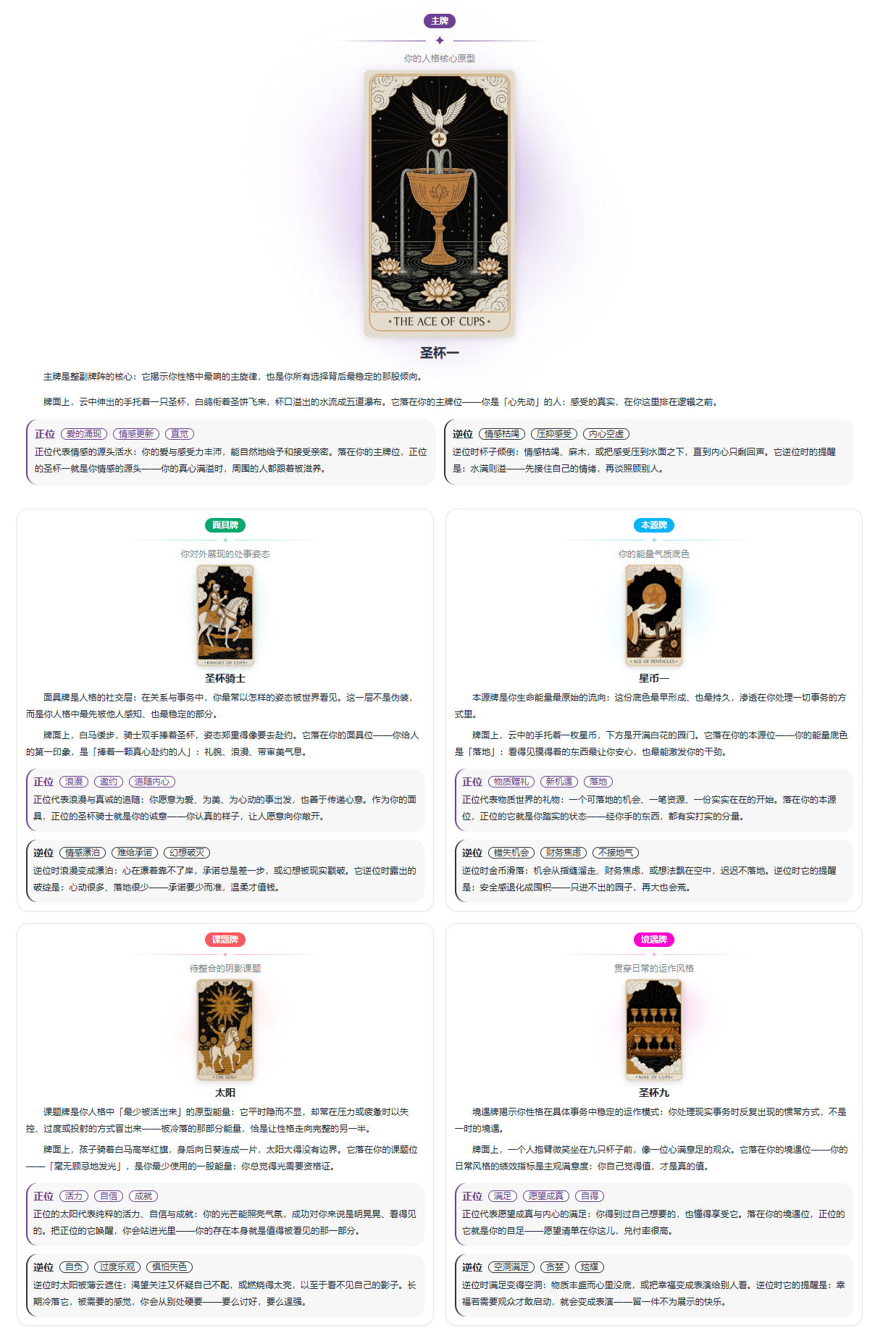 Result preview
05 Main Card Decision and the Five-Card Spread
All 78 cards are scored and ranked: the Main Card is the highest score among the Major Arcana and Aces (in extremely rare ties, the relative method is used first, then the fixed card order). The ranking is divided into five positions by card class — the Mask Card takes the highest court card, the Source Card the highest Ace, the Shadow Card the lowest Major Arcana, and the Stage Card the highest numbered card; none of the four secondary cards repeats the Main Card, and every card has a clear place.
This test is a tool for self-exploration based on the Golden Dawn correspondence system. Results are for entertainment and reflection only and do not constitute any psychological assessment, medical, or career advice.
The Barnum effect is a psychological phenomenon named by psychologist Bertram Forer in honour of P. T. Barnum. People tend to rate vague, general personality descriptions as highly accurate when they believe the descriptions were written specifically for them — even though the same statements could apply to almost anyone. The Barnum effect explains much of the appeal of astrology, divination, personality quizzes and other widely accepted pseudosciences.
Still, these tests can be useful. Like someone who flips a coin to make a decision, what matters is what you were hoping for at the moment the coin left your hand — not the coin's answer. A test can also reveal your subconscious expectations about your own image.
So it is worth looking back at the result together with the process of answering. For a positive suggestion, recognise that it reflects what you hope for yourself, and then act on it. For a negative suggestion, recognise that it is only self-suggestion, and consciously avoid letting it shape you.