
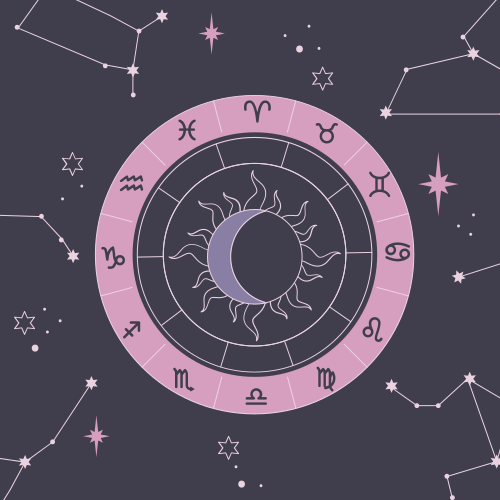
Zodiac Archetype
The twelve signs may be the oldest and most widely spread personality typology still in existence. Its history spans four thousand years — from omens in the skies over Mesopotamia, to personal charts in the Hellenistic world, to psychological astrology and cultural symbolism today. Before starting, it is worth seeing how this system came to be.
c. 2000 BCE Mesopotamia: omens in the sky
The earliest written records of astrology come from Mesopotamia. The Babylonians treated the sky as a noticeboard of divine intent: the position of Venus, the timing of an eclipse — all were carved on clay tablets and linked to harvests, wars, and the fate of dynasties. At this stage astrology concerned only the state, not the individual, and the twelve signs of the zodiac had not yet taken shape.
Around the fifth century BCE, Babylonian astronomers identified twelve constellations along the ecliptic and used them to divide and name the sky — the first time the names of the twelve signs were standardized. From its birth, astrology shared the same tools as astronomical observation; the two only parted ways in the modern era.
3rd century BCE – 2nd century CE The Hellenistic world: the birth of the personal chart
After Alexander's campaigns, Babylonian star tables, Egyptian divine systems, and Greek geometry converged in Alexandria, producing the horoscope: a chart anchored to the moment and place of a person's birth, calculating the positions of the Sun, Moon, and five planets among the twelve signs. For the first time, astrology turned from affairs of state toward individual fate.
In the second century CE, Ptolemy wrote the Tetrabiblos, organizing the four elements, the four qualities of hot, cold, dry, and moist, and planetary influences into a coherent explanatory system. This framework lasted more than a thousand years and is the direct ancestor of today's 'element × modality' typological structure.
8th–15th century CE The medieval and Arab world: translation, preservation, return
After the fall of the Western Roman Empire, Greek astrological texts were systematically translated and annotated in Byzantium and the Arab world. Works by scholars such as Abu Ma'shar were later translated back into Latin through Spain, reigniting astrology's popularity in medieval and Renaissance Europe — where it still sat alongside medicine and meteorology in the university curriculum.
This period also planted the seeds of decline: as the mechanistic worldview and empirical science rose, astrology was gradually pushed out of the academy and retreated into almanacs and folk calendars.
19th–20th century Modern psychological astrology: from fate to personality
The Theosophical movement of the late nineteenth century revived astrology in a new form. Alan Leo shifted the focus of interpretation from 'what will happen' to 'what kind of person are you', laying the groundwork for modern sun-sign culture.
From the 1930s, Dane Rudhyar studied Jung's work and brought Jungian psychology into astrology, treating the chart as a map of personality growth; astrology entered the era of 'psychological astrology'. Today's astrological language — elements, modalities, archetypes, growth lessons — is largely a product of that turn.
Today The zodiac as a cultural typology
From an evidentiary standpoint, the causal link between birthday and personality has never passed a rigorous double-blind test, and the academic consensus is clear. Yet as a language of personality classification that has existed for four thousand years, the zodiac's vitality deserves serious attention: it divides human character into twelve rough archetypes, at a very low cost of discussion, open to everyone.
This is the stance of Zodiac Archetype: we do not validate birthday determinism but reduce the zodiac to typology — a 4×3 structure of four elements × three modalities, in the same lineage as the four temperaments. Forget your birthday and answer an old question in a typological way: which archetype are you most like?
One clarification: we make no predictions of fortune or misfortune and lend no credence to fatalism. This test treats the zodiac as a piece of cultural heritage — the “four elements × three modalities” structure it has left behind is a typological tool people can still use today.
The typological core of astrology reaches back to Empedocles' doctrine of the four roots: fire, earth, air, and water as the four primary substances of all things. Aristotle built on this with the four qualities of cold, hot, dry, and moist, holding that pairwise combinations of these qualities produce the four elements. The Hippocratic–Galenic medical tradition later drew on this to propose the theory of humors, linking the body's four humors — blood, phlegm, yellow bile, and black bile — to four temperament types. Galen finally aligned humoral dominance with temperament, giving the four classic types — sanguine, phlegmatic, choleric, and melancholic — one of the earliest ancestors of Western personality typology.
| Element | Four qualities | Temperament | Core drive |
|---|---|---|---|
| Fire | Hot and dry | Choleric: impulsive, passionate, action-oriented | Will and expression — 'I want to become' |
| Earth | Cold and dry | Melancholic: steady, practical, enduring | Realization and accumulation — 'I want to build' |
| Air | Hot and moist | Sanguine: quick, curious, sociable | Understanding and connection — 'I want to understand' |
| Water | Cold and moist | Phlegmatic: sensitive, receptive, emotional | Feeling and merging — 'I want to feel' |
Astrology adds a second dimension on top of the four elements — the three modalities: cardinal (the start of a season, initiating), fixed (the middle, sustaining), and mutable (the end, adapting). The factorial combination of four elements × three modalities yields 4 × 3 = 12 “zodiac archetypes”: each sign = one element AND one modality. That is the entire theoretical structure of this test.
The test has 12 questions. Each presents one life scenario with four options. You rate each option on a five-point slider: Not at all, Slightly, Unsure, Fairly, Completely. You can move to the next question only after rating all four options. The whole test takes about 3–5 minutes.
We do not ask for your birthday or any birth information — the test cares only about your behavioral preferences and psychological patterns.
The Barnum effect is a psychological phenomenon named by psychologist Bertram Forer in honour of P. T. Barnum. People tend to rate vague, general personality descriptions as highly accurate when they believe the descriptions were written specifically for them — even though the same statements could apply to almost anyone. The Barnum effect explains much of the appeal of astrology, divination, personality quizzes and other widely accepted pseudosciences.
Still, these tests can be useful. Like someone who flips a coin to make a decision, what matters is what you were hoping for at the moment the coin left your hand — not the coin's answer. A test can also reveal your subconscious expectations about your own image.
So it is worth looking back at the result together with the process of answering. For a positive suggestion, recognise that it reflects what you hope for yourself, and then act on it. For a negative suggestion, recognise that it is only self-suggestion, and consciously avoid letting it shape you.