The 16-type model, often called the 16 Personality Types, was created in the mid-20th century by two women who were not trained psychologists. They encountered Carl Jung's theory of psychological types and turned it into a practical system that ordinary people could use, and the four-letter result has since become one of the most familiar personality frameworks in the world.
This article covers the 16-type model, Jung's eight functions, and the popular 16-type websites that sit in between. By the end you will know how the 16-type model came about, how to convert between the four-letter types and the eight functions, and where the nicknames for the 16 personalities come from.
In 1921, the Swiss psychologist Carl Jung published Psychological Types. Its central claim was simple: people differ from one another in fundamental psychological ways.
Jung began with two attitudes:
He then described two perceiving functions:
And two judging functions:
In Jung's model, each of these four functions — S, N, T and F — can carry either an extraverted or an introverted attitude:
Judging functions:
Perceiving functions:
Jung held that the attitude (E or I) of the dominant function determines whether the personality as a whole is extraverted or introverted. For an introverted-dominant person, the dominant function is introverted, but the auxiliary function is usually extraverted, helping the person communicate with the outside world. For an extraverted-dominant person, the reverse is true.
When the model's creators came across Jung's theory, they felt that ordinary people would find it difficult to understand and apply. So they set aside what was most central to Jung — the attitudes of the psychological functions — simplified and quantified his ideas, treated judging versus perceiving as a dimension in its own right, and designed a questionnaire (a scale) that sorted people into different preferences based on their multiple-choice answers.
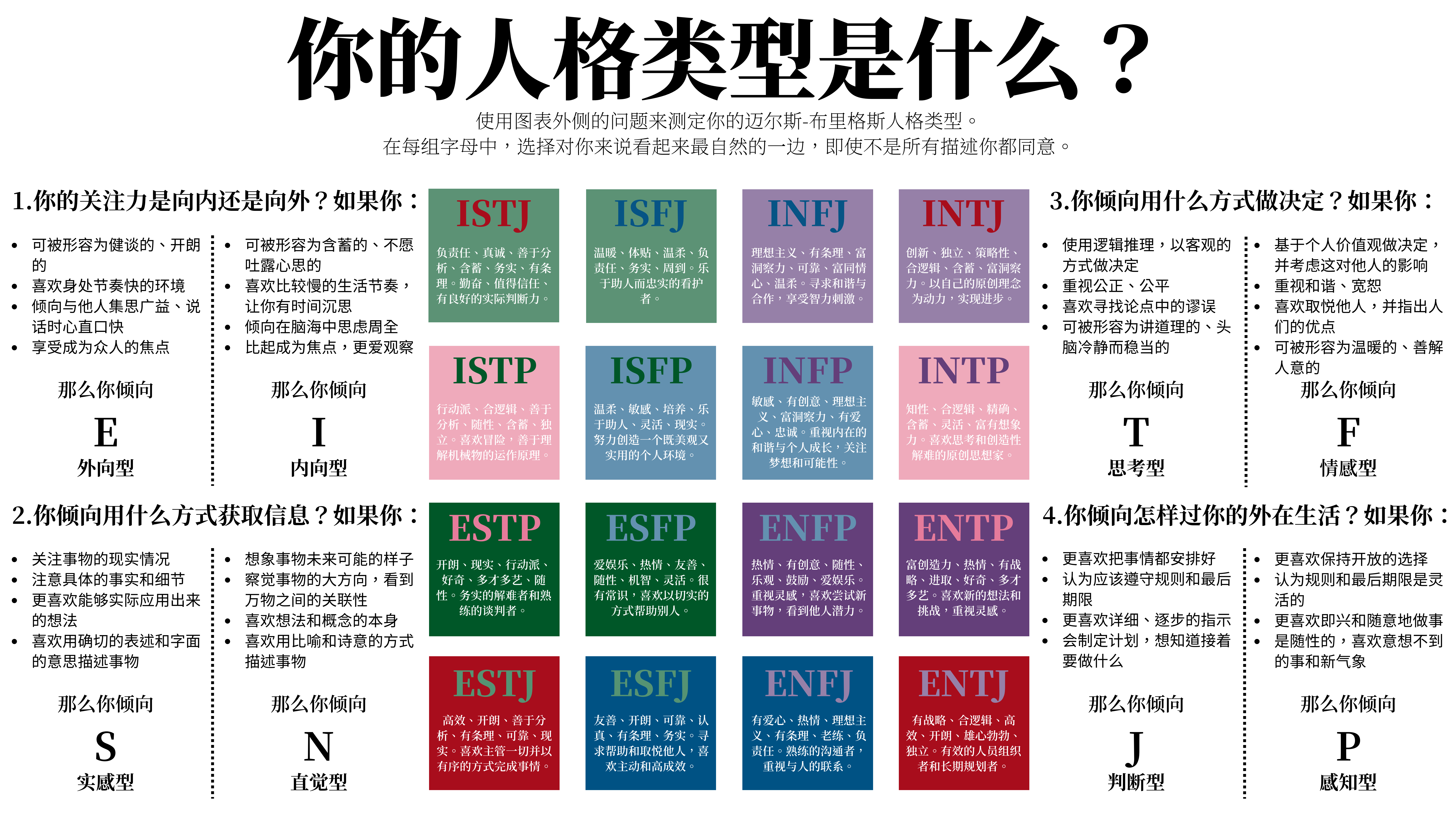
Over decades of development and promotion, the model took its final form, built on four dimensions:
Combined, these four dimensions produce 16 personality types:
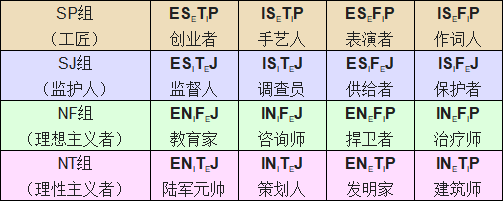
After learning about the 16-type system, a later four-temperament model, with roots in ancient Greek tradition, mapped four temperaments onto the SP, SJ, NF and NT groups and gave each of the 16 types a name of its own.
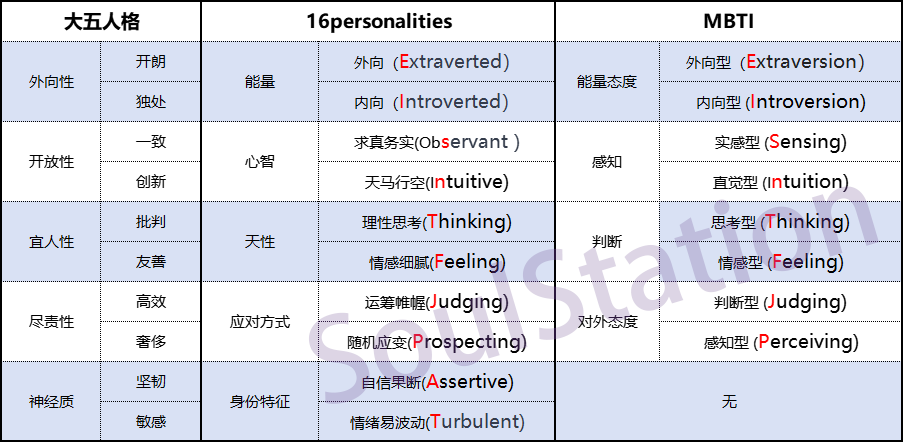
The best-known "16-type test" on the internet is probably a popular 16-type website. The low-poly 16-personality figures that circulate everywhere come from this site.
There is a common misunderstanding here: many people call it the "official 16-type site", yet it is not the 16-type model at all.
The site's own theory pages explain that its framework is based on the Big Five model. It borrows the 16 type names and descriptions from the 16-type system, but the underlying theory and the meaning of the letters are different. The Big Five and this site are trait theories, whereas the 16-type model and Jung's psychological types are type theories — they are built for different purposes.
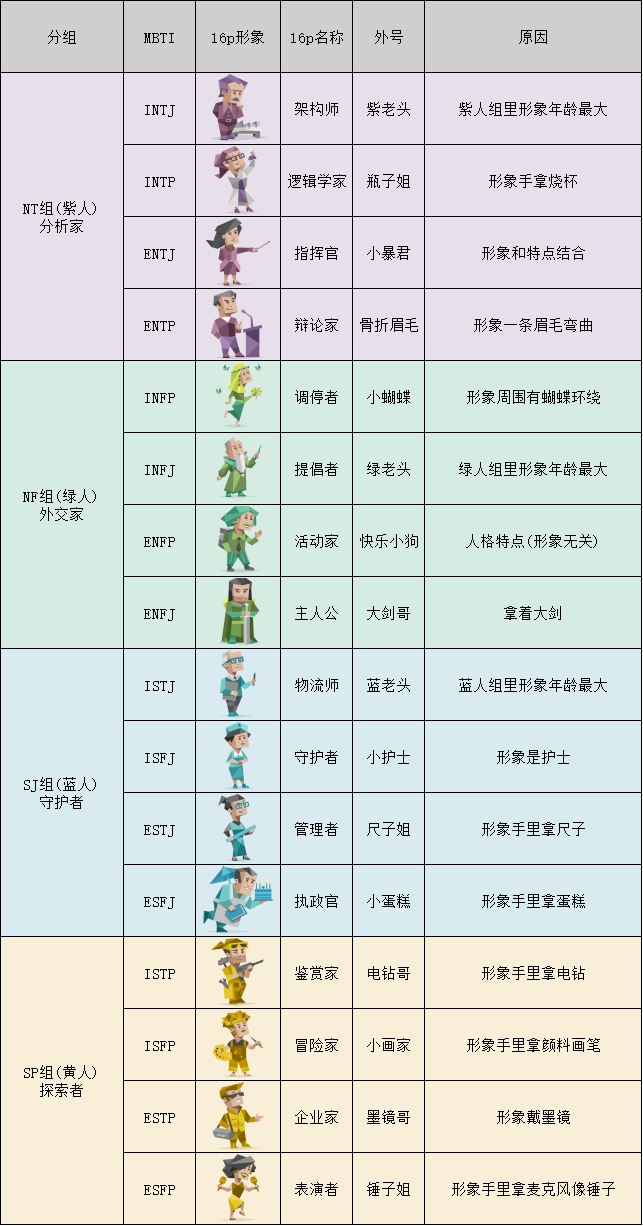
The site's enormous reach has made its personality figures instantly recognizable. Even people who do not regard it as a genuine 16-type test borrow those figures when they create 16-type content. The character designs take their color categories from that four-temperament model and give each figure a distinct set of traits; fans have coined all sorts of nicknames for the 16 types based on those traits.
The eight-function model — the archetypal type model developed by John Beebe — can be read as a deepening of the 16-type model and a return to Jung's original intent. It tries to fill in what the 16-type model leaves out about the dynamics of personality.
The model focuses directly on the eight psychological functions Jung described. It introduces function positions and assigns each position an archetype.
Archetypes are a core concept in Jungian analytical psychology: typical images or patterns that recur across the human collective unconscious.
Beebe argued that the eight functions are not equal within a person's psyche. They occupy different "positions", and each position corresponds to a particular archetypal role that shapes how the function expresses itself and how strongly:
Bright-side functions (the more visible and more frequently used ones):
The anima and the animus are two important Jungian archetypes. The anima is the feminine image in a man's psyche; the animus is the masculine image in a woman's psyche.
Shadow functions (those that remain unconscious):
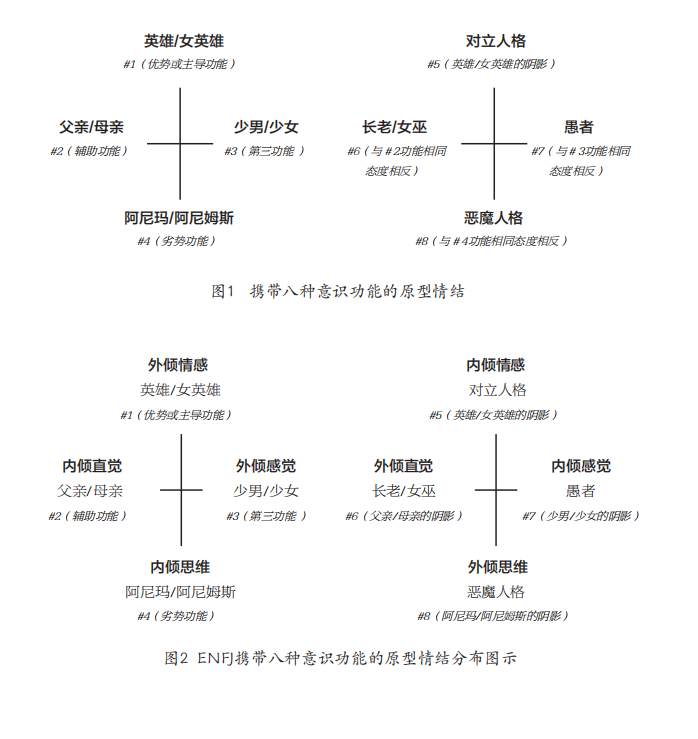
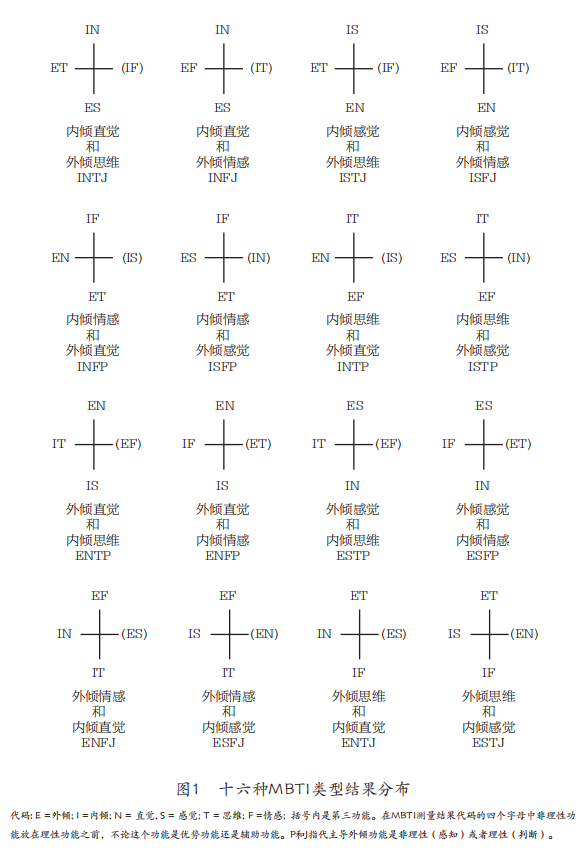
In Jung's theory, adjacent functions take opposite attitudes (E or I): if the dominant function is extraverted, for example, the auxiliary function is introverted.
In the eight-function model, positions 1–4 are called the spine and positions 2–3 are called the arms. Both form axes: when the two ends of an axis are judging functions (T/F), it is a judging axis; when they are perceiving functions (S/N), it is a perceiving axis. Every personality is the intersection of a perceiving axis and a judging axis.
As a result, judging and perceiving functions can never be adjacent: if the dominant function is a judging function, the auxiliary function must be a perceiving function.
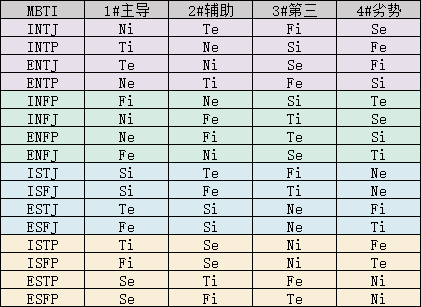
This means that knowing a type's dominant and auxiliary functions is enough to infer all eight. All you need to learn is the mapping between the four letters and the dominant/auxiliary pair.
In the 16-type model, the first letter is understood as the personality's overall introversion or extraversion. In the eight-function model, it is understood as the attitude of the dominant function.
The fourth letter (J for judging, P for perceiving) tells us whether the personality's extraverted function — whichever of the dominant and auxiliary functions is extraverted — is a judging function (T/F) or a perceiving function (S/N).
In other words: J means introverted perceiving (Ni or Si) plus extraverted judging (Te or Fe); P means extraverted perceiving (Se or Ne) plus introverted judging (Ti or Fi).
Author's aside: The stereotype of J (Judging) and P (Perceiving) is "planner versus spontaneous". What does that have to do with judging and perceiving?
J/P can be explained from two angles: the perceiving axis and the judging axis.
From the perceiving axis, J/P expresses a leaning toward the known or the unknown. Ni and Si lean toward the known, the fully knowable, certainty. They gather all the information in different ways, and that makes them feel safe — J. Ne and Se lean toward the unknown and the uncertain. They may find a world in which everything is already known boring, even meaningless, and prefer a constant stream of new, real-time information — P.
From the judging axis, J/P expresses a tendency to act on the outside world. Te and Fe lean toward influencing that world, whether by pursuing outcomes or by shaping the mood around them — J. Ti and Fi are less inclined to affect the outside world. They are satisfied by sorting out logic, reasons, values and the like internally — P.
Take INTP as an example. The P tells us that the perceiving function is extraverted, so it is Ne. The I tells us that the dominant function is introverted, so it is Ti. The first two functions are therefore Ti–Ne.
Applying the rule that adjacent functions take opposite attitudes, and that judging and perceiving functions alternate, we get Ti–Ne–Si–Fe. The shadow functions take the opposite attitude from the bright-side ones, giving Te–Ni–Se–Fi.
Now let's work the other way. Suppose the dominant function is Se and the auxiliary function is Fi. That pins down E, S and F. Since the extraverted function is a perceiving function (Se), the fourth letter is P — the type is ESFP.
If that still feels like a lot to hold in your head, use the quick-reference table:
Although a four-letter type does map onto a specific order of function positions, the eight-function model is more interested in how those functions actually operate inside a person, how they relate to one another, and how they express themselves through different archetypal roles. That is what explains why two people of the same type can behave so differently: their functions may be developed to different degrees, and integrated with their archetypal roles to different extents.
If a simple label is not enough for you — if you want a deeper understanding of how your thinking and feeling actually work, and want to explore the inner structure of your motivation, your strengths, your blind spots and the directions in which you might grow — then returning to Jung's original vision and learning the eight-function model will give you a richer sense of how personality works, and of yourself.
